| What the Media is Saying
Start the Presses
Is the student newspaper lacking in luster? Are you trying get students work published? Do you want to start a website and get students involved?
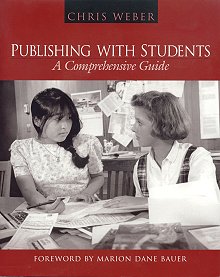
Then get some pointers from Publishing with Students: A Comprehensive Guide by ESL teacher Chris Weber. With 20 years of publication
experience in and out of the classroom, Weber shows you how you can have award-winning publications and spark confidence and creativity in your
students.
NEA Today
[Publishing with Students] A great book for teachers and librarians! Longtime writing teacher
Chris Weber discusses the value of providing your students with opportunities to share their work with a wider audience. He offers practical
suggestions and models for how to publish a student-run magazine or newspaper, how to make hand-bound books, and how to publish student writing on
the Internet. The book includes essays and case studies by other teachers, as well as an appendix full of resources.
Stonesoup.com
Publishing With Students: A Comprehensive Guide by Chris Weber (ESL teacher and Founder of the Oregon Students Writing & Art Foundation) is a first-rate
introduction and instruction text showing parents and teachers how to best help young people on their way to
becoming the next generation of published authors. Individual chapters address the pros and cons of displaying
students work on the Internet, school newspapers and magazines, e-mail publication projects, crucial steps to
successful bookmaking, and much more. Appendixes full of resources round out this informative, practical, user
friendly, and highly recommended question-answering guide.
Midwest Book Review
Expand your students worlds by expanding their audiences. Covering everything from newspaper to magazine to online publishing, Publishing with Students is a handbook for
educators willing to take their students work to a new level. Contributors include art directors, veteran teachers and editors, a Newbery Honor author, former assistant film
directors, and studentsall dedicated to assisting young writers in their own publishing pursuits. The book offers tips and lessons for starting school newspapers, building Web
sites, conducting Internet projects, and more. The author also provides a list of organizations that offer writing contests and publication opportunities for authors ages 5 to
18.
Monica L. Odle
rwt magazine
The Write Stuff
With the recent increase of interest in student writing, librarians may be interested in a new book,
Publishing with Students by Chris Weber (Heinemann, 2002). This comprehensive guide offers suggestions for finding an audience for student writing, a list of competitions and awards, and ways
to use student-run magazines, the Internet, and school newspapers to publish students work.
Association for Library Service to Children Newsletter
The empowered student actively seeks to learn and to grow. Chris Weber gives ample proof of this in Publishing with Students: A Comprehensive Guide. Essays by more than
thirty teachers all reach the same conclusion: Publishing of student writing motivates students to work hard to improve their writing because they have a real audience.
Weber interlaces the essays with his own commentary. It is sometimes difficult to identify the transition from contributor to editor but the message is always the
same.
Getting your students actively involved in the publication process guarantees success, Weber says. A hundred pages later, Dick Swartout marvels at the same thing: Building a
community of staff and student writers . . . defined teaching and learning in a new way.
Weber moves through a series of assumptions and offers supporting evidence from a wide range of teachers. The first assumption is that publication involves students with their
own learning. Second, writing, rewriting, editing, layout, printing, distribution, evaluation all become more valuable the more involved the students are. The final assumption
is that teachers can publish as well. In fact, Weber says, those of you who do [publish] will change yourselves and your students forever.
Publishing with Students begins as a book about how to publish your students writing but draws the teacher in, redefining the teachers role. We should be encouraging our
students to share their work in every way possible. We should be helping our students take ownership of their work. We should be offering them
examples of good writing. We should be writing with them, letting them see us struggle to reach the same goals we have for them. As Ada and
Campoy say, If we are concerned with having our students conceive of themselves as writers, it will be important that they can see the process
evolve in front of their eyes, that they see their teachers also as authors.
Some of the essays focus on the writing. Harold Beedle uses publishing as a culmination for a project on rain forests. He is most interested in research and revision.
Publication gives a clear purpose and understanding to all of the details necessary for a finished product.
Other essayists find the book itself most important. Louise Parms takes her students outside the box when they design their books because the physicality of a bookits look and
design, the way it feels in our hands as we turn or unfold or spread the pages to reveal the mysteries held withincan be as much a part of the process of publishing student work
as the effort that goes into the written content between the covers.
There are specific rules of writing and publishing, the how-to of creating a book. Denise Reagan
describes the effect of different typefaces and spacing and headlines. Sam Swope wants the writing his students publish to be inspired and interesting, and that meant extra
drafts, extra editing, extra cajoling, extra nagging to get the work done well.
The most exciting aspect of this book is the what-then. Once publication has taken place, each of the essay writers reports on the excitement and pleasure and self confidence of
the student authors. Their work has importance, and they have importance.
Two final thoughts about Publishing with Students. The book is full of practical advice about the process and empowering students. But it is also a powerful statement
about the value of student publishing beyond the classroom. Sometimes the audience is other students and parents, but Chris Weber is very much aware of the rest of the world. He
treks in Asia each year to reenergize himself. His collection of essays also reaches out to a larger world, as student writing is used to forge connections between students-in
Belize and Zimbabwe and Brooklyn and Canada and Oregon and everywhere there is a teacher helping students publish. Publishing takes students out of their own community and makes
them part of the whole world.
John B. Ferguson, New Hampshires Writers Project (Book Reviews) |